

The science of clean metal: why weld preparation determines the structure’s life cycle
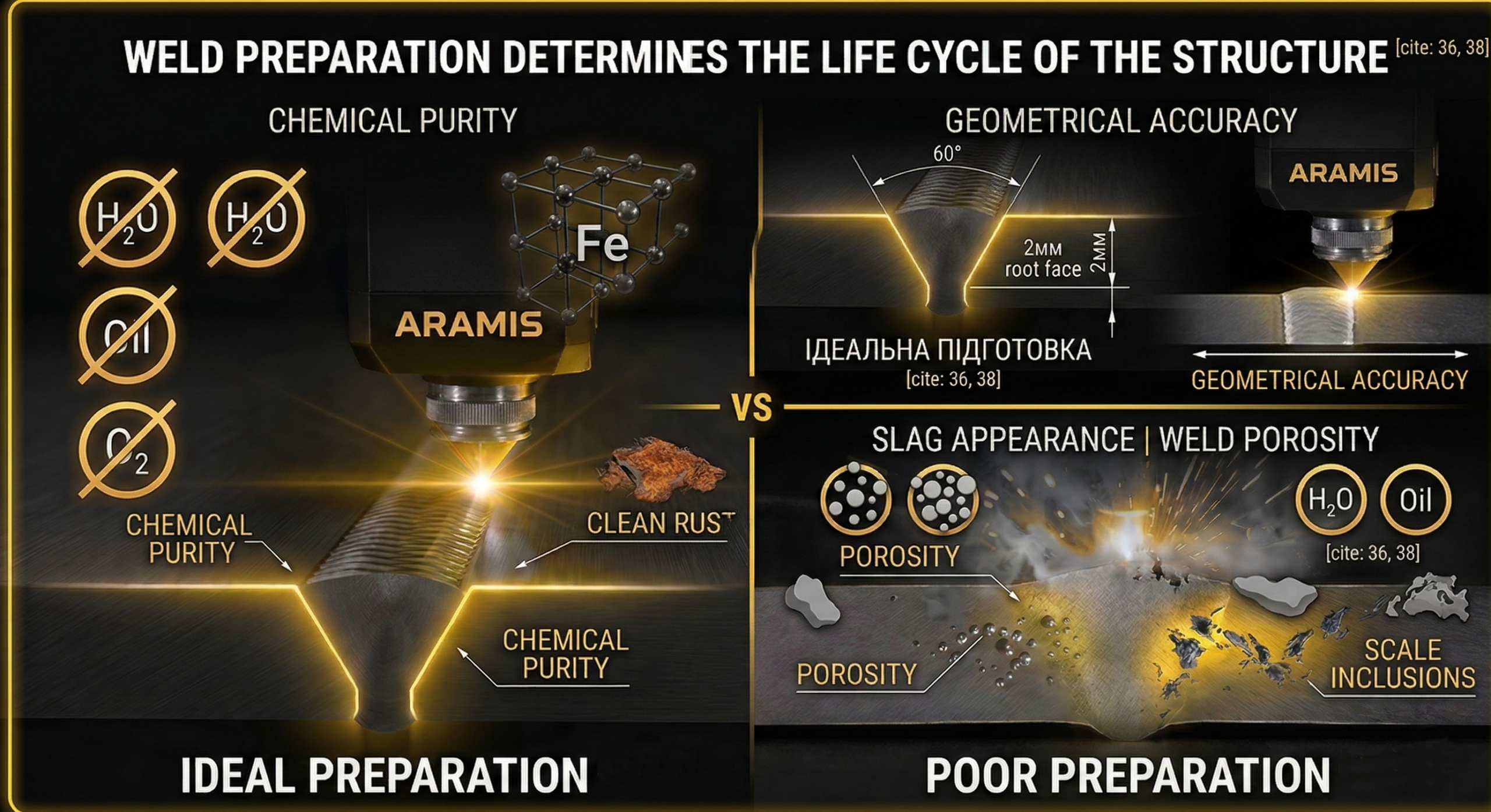
In modern mechanical engineering, the concept of "technological heredity" exists. This means that any microscopic deviation at the initial processing stage will inevitably manifest in the final reliability of the product. That is why metal preparation for welding is considered by ARAMIS specialists as a fundamental physicochemical process, where every micron and every second of exposure matters for the molecular integrity of the future joint. When the question arises of how to prepare metal for welding, it is important to understand not only the mechanics but also the physics of the material.
Surface Chemistry: Fighting the Invisible Enemy
A high-quality weld is the result of ideal metal diffusion. However, standing in the way of this process is scale—a complex layer of oxides formed during hot rolling. It has a different melting point and electrical resistance than the base metal, which makes the arc unstable and leads to spatter.
Yet the real challenge is the destruction of adsorbed layers. Even microscopic residues of lubricants or moisture decompose under thermal influence, releasing hydrogen. It is hydrogen that is the main cause of weld porosity, a defect that critically reduces structural strength. To avoid this, professional metal cleaning before welding and thorough metal degreasing must be performed with an understanding of gas kinetics. Here, it is vital not just to "wipe the surface" but to remove the film at a molecular level.
Edge Geometry as a Means of Energy Management
When we say at ARAMIS that every micron matters, we are talking about the energy balance of the weld pool. Proper edge processing is essentially programming how heat will be distributed in the joint zone.
The metal bevel must be executed with precision angular accuracy. A deviation of just a few degrees changes the volume of the deposited metal, leading to either lack of fusion or overheating of the heat-affected zone.
For different materials, the preparation strategy differs cardinally. For example, steel preparation for welding requires a focus on removing the defective layer after thermal cutting. Meanwhile, aluminum preparation for welding is a jewelry-like task involving the oxide film, which cannot simply be scraped off with coarse abrasives to avoid "rolling" oxides deeper into the soft structure.

Why is the Engineering "Feel" for the Machine Decisive?
It is at the preparation stage where the physics of the process intersects with the expertise of those who actually create the tools for this processing. Specialists at the ARAMIS service department work on equipment of the same brand, designed and assembled at this very plant. This creates a special level of process understanding.
People who perform metal preparation know their equipment from the blueprint stage to the last screw. This in-depth knowledge allows them to tune the machinery so that every prepared part has the ideal micro-geometry for future fusion. Understanding the internal architecture of systems and the stability of their components allows for the elimination of the smallest errors and vibrations. As a result, edge processing is so clean that the welding arc remains stable throughout the pass, and welding quality reaches a new level due to an ideally formed base.
Ultimately, welding quality is an integral indicator where the technical excellence of equipment combines with the master's intellectual approach. When preparation is performed by people who know the equipment's architecture from the inside, metal ceases to be just a raw material. It becomes the base for a flawless joint, where every detail is prepared with consideration for its "inner life" and future loads. Such a scientific approach to preparatory work is the only true way to create metal structures where reliability is guaranteed by the very nature of the technological process.
You may also like Related Articles
When you walk into a modern workshop in 2026, the first thing you notice is the silence. No, the machines are working, the metal is being cut, and sparks are flying as they always have. But the “rhythm” of production itself has changed. The hustle is gone. Today, metalworking is no longer about physical strength; […]

Why doesn’t your laser cutting machine deliver perfect results? Why does the metal overheat, leave slag, or fail to cut through completely? How can you avoid equipment downtime and reduce maintenance costs? This article will help you understand the most common mistakes when working with a laser cutting machine and teach you how to avoid […]