

Top Innovations of 2025 in Metalworking: Trends That Are Changing the Market
- Bevel Cutting: Versatility and Precision in One Solution
- Replacing Plasma Cutting with Laser: A New Quality Standard
- Processing Thick Metals: Why Are Manufacturers Switching to Laser?
- Automation for Laser Machines in Metalworking: Efficiency and Innovation
- Key Automation Systems for Laser Machines
- Conclusion
How to Stay Competitive in Today’s Metalworking Market? What Technological Innovations Can Boost Production Efficiency and Optimize Costs?
The metalworking industry is on the verge of revolutionary change! Technologies that seemed unattainable just a few years ago have now become an integral part of the strategies of market leaders.
Innovation in metalworking is more than just a trend — it’s your competitive advantage in a market where precision, speed, and cost-effectiveness are the key demands of customers.
In this article, we will take a detailed look at the key factors shaping the future of metalworking and how these solutions can help improve your business efficiency and optimize production processes.
Bevel Cutting: Versatility and Precision in One Solution
Bevel cutting is an innovative method of metal cutting where the cut is made at an angle to the surface rather than strictly perpendicular. This method is used to create beveled edges (chamfers), which are required for welding, sealing, or decorative finishing.

How It Works:
Modern machines with bevel cutting functionality are equipped with control systems that allow you to set the precise cutting angle. Bevel cutting enables immediate creation of chamfers, preparation of edges for welding, and production of complex angled parts.
Advantages:
- One machine instead of two. A laser complex with bevel cutting functionality performs tasks that previously required several different machines — a laser machine for metal cutting and a milling machine.
- Cost reduction. No physical wear of tools and minimal metal waste significantly reduce production costs.
- Flexibility in operation. The technology allows working with complex shapes, areas, and various types of metals.
- Precision and flawless quality. Bevel laser cutting guarantees smooth, clean edges with minimal tolerances, which is especially important for welding.
- Reduced manpower requirements. All processes are automated and do not require manual adjustments.
- Elimination of additional post-processing. Thanks to the precision and cleanliness of the cut, operations such as grinding can be skipped, saving even more time and resources.
Bevel cutting is not only about technical excellence but also about new opportunities for those who want to stay competitive in the market. Implementing this technology helps manufacturers produce top-quality products while using fewer resources.
Replacing Plasma Cutting with Laser: A New Quality Standard
It used to be thought that laser machines were only suitable for fast, precise cutting of thin metals, while plasma systems were used for cutting thick materials where high quality and precision were not required. This was due to the limitations of low-power lasers (0.5–2 kW), which cut thick metals slowly, often caused overheating, and as a result, left rough edges.
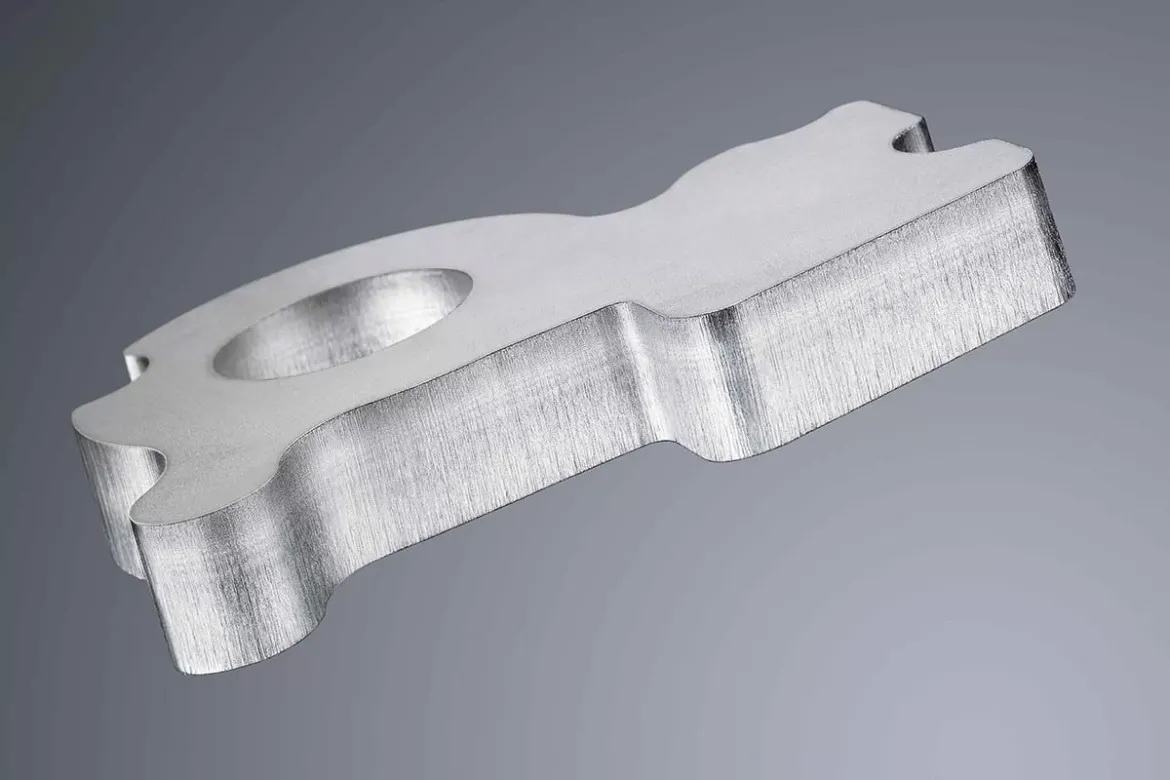
Modern technology has completely changed the approach to metalworking. Thanks to lasers with power levels of 6–20 kW, cutting speed has significantly increased, and cut quality remains clean even on thick metals. Higher cutting speeds prevent material overheating, minimize deformation, and ensure perfectly smooth edges. Now, even on thick metals, it is possible to create sharp angles, eliminate hole tapering, and fully avoid additional post-processing like deburring.
In addition, modern lasers are more energy-efficient. With optimized technologies and lower consumption of consumables like gases, production has become more cost-effective and environmentally friendly compared to plasma systems.
Processing Thick Metals: Why Are Manufacturers Switching to Laser?
Previously, plasma cutting was considered the optimal choice for processing thick metals due to the lower cost of equipment and high cutting speed. However, advancements in laser technology have completely changed the situation.
Modern high-power lasers with output power of 12–20 kW have become more affordable, allowing them to easily replace plasma cutting in the processing of thick metals, such as carbon steel or stainless steel with thicknesses up to 30–50 mm.
Thus, laser technology has become not only more efficient but also more cost-effective, thanks to reduced energy consumption and minimal need for further part processing. This explains the active transition of manufacturers to lasers as a universal solution for cutting metals of various thicknesses.
New Horizons for Manufacturing
The shift from plasma to laser technology allows enterprises to achieve a level of quality that was previously unattainable. For manufacturers aiming to remain competitive, laser cutting is becoming the standard that meets the demands of modern industry.
Choosing laser technology is an investment in the future of manufacturing — one that will be cost-effective, flexible, and capable of meeting the needs of even the most demanding customers.
Automation for Laser Machines in Metalworking: Efficiency and Innovation
Modern industry requires maximum precision, productivity, predictable planning, and resource efficiency. Process automation in laser machines has become a foundation, opening new opportunities for companies seeking to boost productivity and maintain competitiveness.

Why is automation important?
- Stability and repeatability. Reduction of human error risks thanks to robotic systems.
- 24/7 productivity. Machines operate without breaks, delivering consistent quality.
- Resource savings. Reduced need for manual labor and optimized energy consumption.
- Execution speed. Work is completed faster, reducing production cycle times.
Key Automation Systems for Laser Machines
| Automation System | Description | Advantages |
|---|---|---|
| Metal feeding system | Automatic feeding of blanks into the processing area to speed up preparation stages. | 1. Time savings on loading. 2. Reduced need for personnel — one operator can replace a full team, handling loading and processing alone. 3. Lower material damage risk. |
| Metal unloading system | Automatic transfer of finished parts using manipulators or conveyors. | 1. Fast unloading of products. 2. Automatic sorting of finished parts. 3. No damage during transport. |
| Integration with other systems | Integration of laser machines with CAD/CAM programs and cloud management platforms. | 1. Automatic drawing upload. 2. Real-time monitoring. 3. Unified and systematized process. 4. Savings in time and labor. 5. Automatic inventory management and waste reduction. 6. Shorter production cycles. 7. Planning and reporting system creation. |
| Maintenance forecasting | Equipment condition analytics to prevent downtime. | 1. Downtime prevention thanks to maintenance forecasting. 2. Reduced reliance on manual labor. 3. Lower operating costs. |
Benefits for production
- Increased efficiency. Automated systems work 2–3 times faster.
- Reduced defects. High-precision equipment minimizes errors.
- Cost optimization. Savings on labor, materials, and electricity.
- Flexibility. Easily adapts to new tasks.
- Predictability. Automation enables accurate forecasting and planning, making production plan fulfillment virtually independent of the human factor.
Why is automation the future?
Implementing automation is an investment that pays off by accelerating operations, reducing costs, and improving product quality. In today’s world, it’s not just an advantage — it’s a necessity for successful business.
Conclusion
Innovation in metalworking is the key to success in today’s competitive environment. By implementing advanced technologies like bevel cutting, laser cutting of thick metals, or automation, you not only enhance production quality and productivity but also lay a solid foundation for long-term business growth.
Ready to keep pace with the times? The choice is yours. But remember: the first step toward innovation is the right partner who will help integrate these solutions into your business.

XXI INTERNATIONAL INDUSTRIAL FORUM (Kiev, Ukraine) ITM INDUSTRY EUROPE 2023 (Poznań, Poland) Address: International Exhibition Center, 15 Brovarskyi prosp., Kyiv, Ukraine Stand: Pavilion 2A Place A12 The event is to be held on: May 30th – June 01st , 2023 Registration: here Address:Poznań International Fair, Glogowska 14, 60-734 Poznań, Poland Stand: PAW 8 ST 23 […]

Most of ARAMIS TM machines designed for laser metal machining are supplied with Metalix control program compilation system, which allows to work with CAD drawings (formats: DXF; IGES; DWG), to carry out optimal nesting of parts on a sheet of metal, to set micro-bridges, to set the sequence of works, to automatically generate machine code […]
ARAMIS has successfully concluded its participation in the International Industrial Forum, the country’s premier industrial event. For three days, our team was at the epicenter of the action, demonstrating the capabilities of modern Ukrainian machine building, providing professional consultations, and establishing new partnerships. This year’s Forum clearly demonstrated that despite all challenges, the interest of […]


At our stand, you will not only see advanced equipment for metal processing, learn about its advantages and capabilities, but also be able to ask questions of our specialists, discuss individual terms of financing, deliveries, etc. So see you in KYIV. Address: International Exhibition Center, 15 Brovarsky prospect, Kyiv, Ukraine Stand: pavilion 2A place F01 […]

January 10, 2024 The ARAMIS company continues its successful evolution thanks to participation in the state program “eRobota” and makes investments in the development of its production. One of the grant programs of this initiative is the “New Level” program for processing enterprises, which gives entrepreneurs the opportunity to receive up to 8 million hryvnias […]

The International Industrial Forum, which took place at the end of May 2024 in Kyiv, pleasantly surprised both the number of participants and the number of truly interested visitors. This suggests that, despite the war in our country, there is considerable demand for industrial equipment and the gradual recovery of the market is beginning.Many enterprises […]

At the same time, some of the visitors even managed to try to work on the equipment and clean the rust off a real part. The speed and precision of cutting, as well as the simplicity of the welding and cleaning process, has caused sincere delight not only among the students, but also among the […]

This year has been a true test for us and, at the same time, a year of great achievements. Despite challenges related to the war, unstable energy supply, and missile strikes, Aramis not only persevered but also achieved significant success, highlighting our resilience, professionalism, and innovative potential. Launch of a Joint Program with USAID to […]