

How to choose the right manual laser welding system

- Understanding the basics of manual laser welding systems
- Factors to be taken into account when choosing a manual laser welding system
- Type and thickness of the material
- Welding speed and precision
- Workpiece size and shape
- Budget
- Ease of operation and maintenance
- Technical support and personnel training
- Conclusions
- FAQ
- What is laser welding and how does it work?
- What materials can be welded with a manual laser welding machine?
- Can a manual laser welding system be used for both small and large parts?
Laser welding is becoming increasingly popular in the manufacturing industry due to its accuracy, speed and versatility. However, choosing the right laser welding system for your specific needs can be a complicated task. In this article, we will provide a comprehensive guide to selecting the right manual laser welding system.
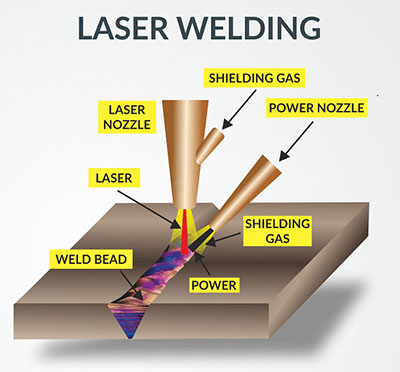
Understanding the basics of manual laser welding systems
Before going deeper into the specificity of choosing a manual laser welding system, it is important to understand the basics of this technology.
A manual laser welding system usually consists of:
✓ laser source,
✓ optical welding manipulator,
✓ cooling system
✓ control unit.
Laser source creates a concentrated energy flow, which is focused on the materials being welded. Power supply unit controls the intensity and duration of the laser beam, and cooling system prevents overheating of the laser source and other components.
Control unit enables the operator to control the welding process and adjust the parameters when needed.
Factors to be taken into account when choosing a manual laser welding system
Several factors must be taken into account when choosing a manual laser welding system.
To make the right choice, take into consideration:
- specifications of the metal to be worked with
- specific features of the product design,
- working conditions,
- possibilities for specialized training of employees,
- budget capacity.
Type and thickness of the material
Type and thickness of the material to be worked with are determining factors in identifying the type of laser welding system you need. Certain materials, like non-ferrous metals, which have high back reflection factor, Require a more powerful laser source. Similarly, thicker materials require a more powerful laser for penetration into the material and efficient welding.
Welding speed and precision
The speed and precision of the welding process are important factors as well. If you work with orders for large serial batches, high welding speed can be needed. On the other hand, if precision is essential, a lower welding speed may be required, but, instead - more strict control over accuracy and quality of the weld seam.

Workpiece size and shape
Workpiece size and shape are also of great importance in determining the type of laser welding system you need. If you work with small-size but complex-shaped parts, you might need a system with a smaller laser beam diameter. And vice versa, if you work with large-sized items, a system with a larger working area may be required.
Budget
Of course, when choosing any equipment or technology, the budget is always taken into account. The price of manual laser welding systems can vary within the range from several thousand dollars to hundreds of thousands, depending on technical specifications and capabilities.
 Ease of operation and maintenance
Ease of using and maintaining the system should also be taken into account. Look for a system with a user-friendly interface and components that are easy to replace.
The most common types of manual laser welding machines are as follows:
1. Water-cooled systems
Machines of this type are cheaper, but at the same time larger, heavy and less mobile (250+ kg);
2. Air-cooled systems
Such devices are lightweight (up to 60 kg) and mobile, but they are much more expensive.
Technical support and personnel training
Finally, pay attention to technical support and personnel training, provided by the producer. Choose the one that offers comprehensive training and support to ensure you can properly operate and maintain the system.

Don’t forget to take into account material type and thickness, welding speed and precision, workpiece size and shape, ease of use and maintenance, as well as technical support and personnel training.
Conclusions
Choosing the right manual system of laser welding may seem to be a complicated task, but by considering the factors above, you can narrow down your choices and select the system that best suits your needs and budget. Remember to take into account the type and thickness of the material, welding speed and precision, workpiece size and shape, ease of use and maintenance, as well as technical support and personnel training. With the right system, you can take advantage of the precision and versatility of laser welding in operations and manufacturing processes.

FAQ
What is laser welding and how does it work?
Laser welding is a process where a concentrated beam of light is used to fuse materials together. The laser beam creates a high energy area that melts the materials and forms a strong bond when it cools down.
What materials can be welded with a manual laser welding machine?
Manual laser welding machines can be used to weld a wide range of metals, including ferrous steel, stainless steel, aluminum, copper.
Can a manual laser welding system be used for both small and large parts?
Yes, manual laser welding machines are suitable for welding any parts
These articles might be of interest for you

In case of industrial equipment, the decision to purchase used equipment requires careful consideration. This is especially true for used laser cutting machines, a technological asset that can be a blessing or a curse depending on the specific circumstances.

Advantages of ordering metal cutting services Provision of metal cutting services by a professional contractor can provide many advantages for the business. Here are some of the main ones: 1. Cost effectiveness: Outsourcing can be more cost-effective than purchasing of in-house equipment, especially for companies with small production volumes. It eliminates the need for expensive […]

How to choose a laser machine for metal cutting? Owners of industrial enterprises for the manufacture of metal products are paying increasingly careful attention to laser machines for metal cutting, which feature versatility, reliability and high precision. That goes without saying: when purchasing such equipment, the question arises quite naturally – what characteristics of the […]

What is laser cutting of metals? Metal laser cutting is a process where a laser beam is applied to cut metal parts to a specific size and shape. This method of metal processing is the most precise and efficient compared to other cutting methods, such as plasma cutting or gas cutting.

Usually the machine breaks just when you need it the most Imagine: your machines stop just when you need them most. It’s a scenario we’ve all faced. Many manufacturing companies rely on systems that have faithfully served them for many years. However, even a well-maintained system will wear out, primarily in its mechanical components. […]

1. Selection of equipment without proper research. Problem: Buying a laser machine is a big investment, and you don’t want to waste money on equipment that doesn’t meet your needs. Solutions: Do thorough market research, available technologies, and ways to solve your needs. Compare them and choose the technology that best suits your production needs. […]


The reasons why Chinese metal cutting machines are so attractive for Ukrainian manufacturers. Relatively low price is the main advantage of Chinese laser machines. Besides, manufacturers are often attracted by the wide assortment of products and the opportunity to save money on the initial cost of the equipment. Low cost: Machines from China are […]

This machine features: Ytterbium fiber laser Linear motors Suitable for cutting of metal in large amounts. Vector speed up to 250 m/min Cutting speed up to 60 m/min Accuracy of positioning and repeatability: 0.01 mm Laser source power: 2-6 kW 4 monitoring cameras.

Understanding the basics of manual laser welding systems Before going deeper into the specificity of choosing a manual laser welding system, it is important to understand the basics of this technology. A manual laser welding system usually consists of: ✓ laser source, ✓ optical welding manipulator, ✓ cooling system ✓ control unit. Laser source creates a concentrated energy flow, […]

Metalworking technologies have been evolving for several centuries and offer a wide range of options for solving the issue. Today, the most popular options are laser and plasma cutting. Let’s take a look at which method is better. To be honest, this question is not a valid one, as each type of machine tool is […]


At the same time, some of the visitors even managed to try to work on the equipment and clean the rust off a real part. The speed and precision of cutting, as well as the simplicity of the welding and cleaning process, has caused sincere delight not only among the students, but also among the […]

Most of ARAMIS TM machines designed for laser metal machining are supplied with Metalix control program compilation system, which allows to work with CAD drawings (formats: DXF; IGES; DWG), to carry out optimal nesting of parts on a sheet of metal, to set micro-bridges, to set the sequence of works, to automatically generate machine code […]